Data science is operating in a moment of paradox. We have more data, more tools, and more computational power than ever before — yet many of the core challenges feel stubbornly human.
In this video, experienced practitioners from varied backgrounds reflect on what they see as the biggest obstacles facing the profession today.
This video is part of our thought-leadership series, RWDS Big Questions, where members of our community answer one key question in multiple ways, offering diverse perspectives from across the industry.
Watch the video below to hear insights that span technical, organisational, and personal dimensions. Together, they reveal a set of deeply connected themes and, importantly, opportunities for the field to mature. Scroll down for analysis and practical takeaways.
Video: What Are the Key Challenges Facing Data Scientists Today?
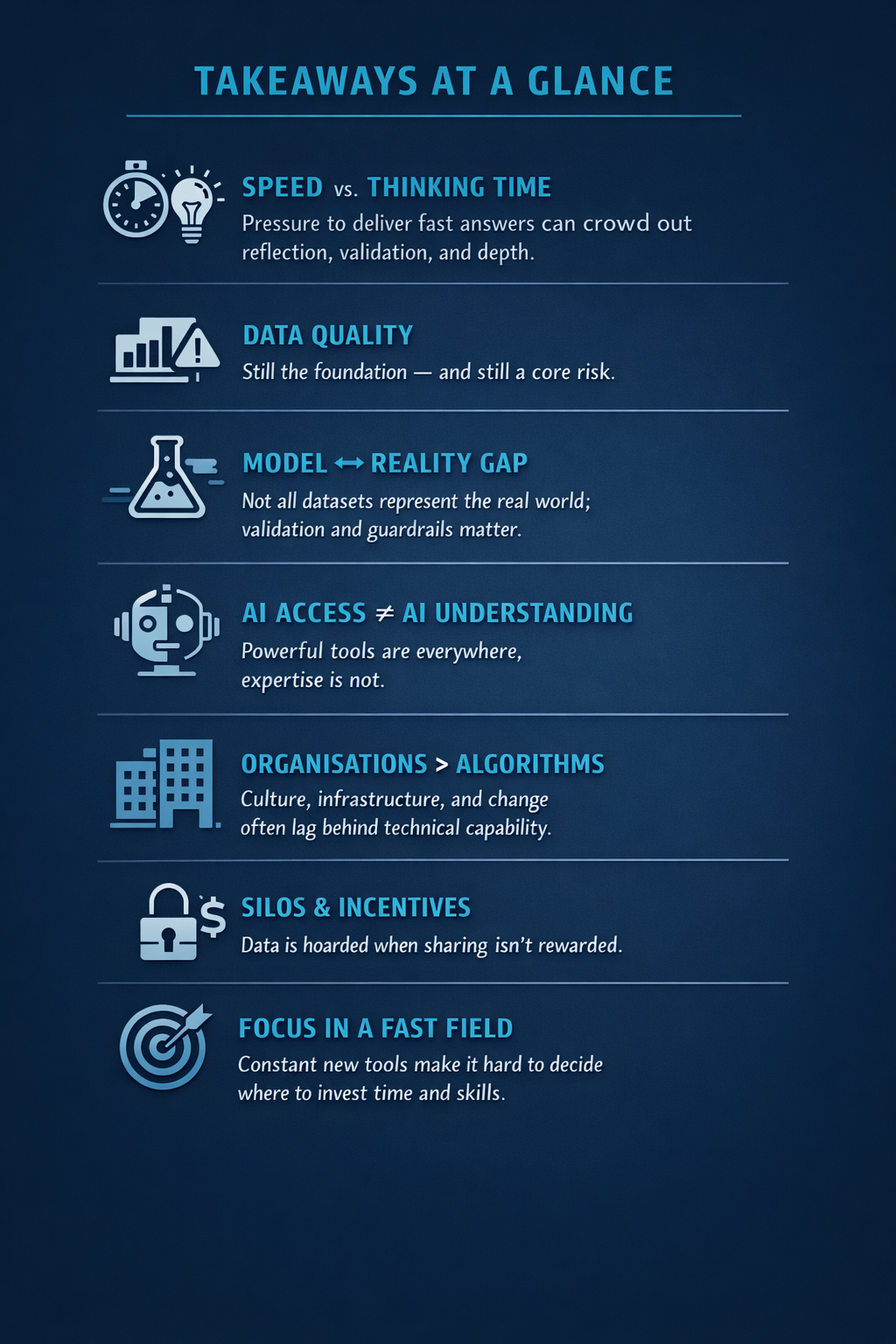
The Patterns Behind the Problems
Although the challenges raised span technical, organisational, and personal domains, they are connected by a small number of deeper themes that shape modern data science.
The gap between capability and understanding
Across multiple perspectives, there is a recurring mismatch between what our tools can do and how well we understand their limitations. From AI systems trained on poor-quality data to models built on artificial or incomplete datasets, technical capability is often outpacing validation, interpretation, and critical scrutiny.
This gap widens further as advanced tools become more accessible to non-specialists, increasing the risk of confident but flawed outputs.
Speed amplifies existing weaknesses
Pressure to move quickly doesn’t create new problems so much as it magnifies existing ones. Poor data quality, weak validation, and organisational silos become far more consequential when decisions must be made rapidly.
The demand for instant answers leaves little room for reflection, experimentation, or uncertainty — despite these being essential to good data science.
Data science is constrained by its environment
Many of the challenges raised point away from algorithms and towards the environments in which they are deployed. Organisational readiness, digital infrastructure, and especially incentive structures strongly shape how data science is practiced and whether it creates impact.
When teams are rewarded for control rather than collaboration, silos persist, data sharing becomes risky, and even the most robust models struggle to influence decisions.
Uncertainty is a constant
The personal experience of data scientists mirrors these structural challenges. In a field defined by rapid change, uncertainty about where to focus, what to learn, and how to stay relevant is common.
This is not just a skills issue, but a signal that data science is still evolving, without a single, stable definition of what “good” looks like.
Looking Ahead
Taken together, these themes suggest that the biggest challenges in data science are not isolated problems to be solved individually. They are interconnected tensions between speed and rigour, access and expertise, innovation and organisational inertia.
Addressing them requires interdisciplinary, systems-level thinking.
Which of these challenges resonates most with your own experience in data science? How can practitioners use these tensions as inflection points to actively shape the field, rather than simply react to it?
- About the author:
- Annie Flynn is Head of Content at the Royal Statistical Society.
Copyright and licence : © 2026 Annie Flynn

 This article is licensed under a Creative Commons Attribution 4.0 (CC BY 4.0) International licence.
How to cite :
Flynn, Annie 2026. “RWDS Big Questions: What are the Key Challenges Facing Data Scientists Today?” Real World Data Science, 2026. URL